Agent concepts electronics engineers actually need to know
You don't need to understand transformers to get value from AI. You do need eight working concepts — agent, tool call, context window, orchestration, grounding, determinism, evals, and the review gate — because they decide what these systems can and can't be trusted with.
 James Pentalow · VP of Revenue, Circuitly
7 min read
James Pentalow · VP of Revenue, Circuitly
7 min read
Most explanations of AI agents are written for software people, by software people, with examples about booking flights. Meanwhile the actual decisions in an electronics organization — what to automate, what to trust, what vendor claims are physically possible — land on engineers who were never given the vocabulary in terms that map to their work.
This is that vocabulary. Eight concepts, no math, every example a board. They're worth thirty minutes because they're load-bearing: teams that hold these concepts make sane automation decisions, and teams that don't end up either trusting a chatbot with a BOM or banning AI outright after the first incident. Both are expensive.
An agent is a model in a loop with tools. Tools give it ground truth; the context window bounds what it can hold; orchestration splits big jobs across many agents; deterministic checks verify anything with a right answer; evals measure whether any of it works; and the review gate keeps a human on every merge. Master those and vendor demos become legible.
1. An agent is a model in a loop
A raw language model is a function: text in, text out, done. Ask it a question, get an answer, and the transaction ends. Everything it "knows" was frozen at training time.
An agent is that same model placed in a loop with the ability to act: it receives an objective ("find a current-sense monitor that meets these requirements"), decides on a step, executes it, observes what happened, and decides again — iterating until the objective is met, it hits a wall, or it needs a human decision. The intelligence is the model's; the agency comes from the loop.
The EE analogy is the difference between asking a consultant a question and giving a contractor a work order. The consultant answers from experience and leaves. The contractor goes and measures, orders materials, hits a surprise behind the wall, adjusts, and comes back with the job done and a record of what happened. Once you see the distinction, vendor marketing gets much easier to parse: a "copilot" that answers questions is a consultant. An agent does work — which is both why it's more valuable and why it needs supervision structures a consultant doesn't.
2. Tool calls are how agents touch ground truth
On its own, a model can only emit text from memory — and its memory is an approximate compression of the pre-training internet. The mechanism that fixes this is the tool call: the model requests that real software run — search_digikey("INA226AIDGSR"), run_drc(board), read_plm_requirement("REQ-PWR-0042") — and gets structured results back to reason over.
This is the single most important concept on this list for electronics, because it's the answer to the hallucination problem. A model asked from memory what package the INA226 comes in might be right. A model that calls the distributor API is right, or knows it isn't. The engineering rule that follows:
Judge an AI system by what its model is allowed to answer from memory. Facts that matter — pinouts, stock, absolute maximums — should always arrive through a tool.
3. The context window is the bench, not the brain
A model's context window is its working memory: everything it can consider at once — your instructions, the files it's read, its tool results, the conversation so far. Modern windows are large (hundreds of pages), but two properties matter more than size. It's volatile: each session starts empty, and nothing persists unless deliberately written somewhere durable. And it degrades under load: pack a window with three full datasheets and a netlist, and the model's attention on any one detail gets measurably worse — much like an engineer's bench, where the more you pile on, the harder it is to find the one footnote that matters.
Practical consequences: systems that feed agents relevant extracts (the regulator's electrical-characteristics table, not the 400-page family datasheet) outperform systems that dump everything in. And "the AI forgot what we discussed last week" isn't a bug report — it's a description of the architecture, and the fix is durable storage the agent reads and writes through tools, not a bigger window.
4. Orchestration: why it's a tree of agents, not one big one
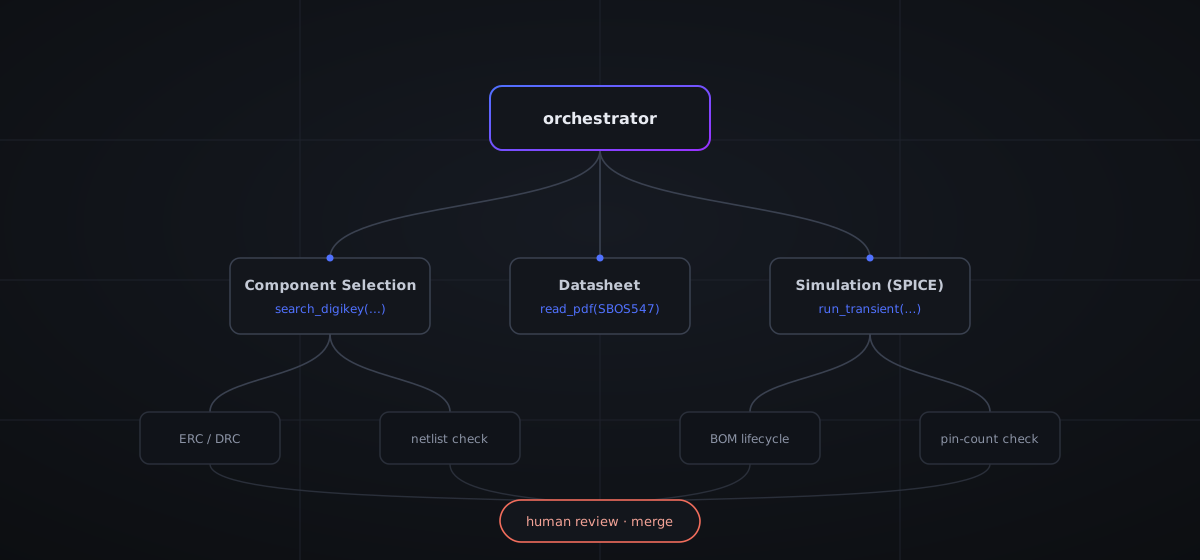
Given finite, degrading context, serious systems don't use one agent — they use many, arranged deliberately. An orchestrator decomposes the objective ("select and verify a power monitor for this design") into scoped tasks and dispatches sub-agents, each with a clean context holding only its own job: one searching distributors, one deep in the candidate's datasheet, one running SPICE on the front-end, one checking enclosure clearance against the MCAD model. Results flow back up; the orchestrator reconciles conflicts and assembles the answer.
This should feel familiar, because it's how engineering teams already work — a lead decomposing a design across specialists, then integrating. The reasons are even the same: focus beats breadth, parallelism beats serialization, and a specialist with exactly the right five documents beats a generalist buried under fifty. When a vendor says "multi-agent," this decomposition — not head-count of models — is the substance to look for.
5. Grounding, or: where did that number come from?
Grounding is the discipline of making every consequential claim traceable to a source: this stock figure came from the DigiKey API at 14:02, this thermal limit from SBOS547 revision C page 7, this height constraint from the enclosure model in Onshape. Ungrounded systems produce answers; grounded systems produce answers with provenance.
For electronics teams the test is simple and worth running in every demo: ask "where did that come from?" about any part number or specification the system emits. A grounded system shows you the tool call and the source document. An ungrounded one restates the claim more confidently. You already know which of those you'd let near a BOM — you apply exactly this test to junior engineers.
6. The deterministic layer: code checks what code can check
Agents are probabilistic — the same question can get a differently-worded answer twice. That's tolerable, even useful, for judgment. It is intolerable for verification. No one wants a pin-count check that's usually right.
So trustworthy systems are two-layered. Questions with a right answer — does the netlist match the schematic, does the footprint's pad count match the datasheet, does any BOM line reference an EOL part, does the layout pass DRC — run as deterministic code: same input, same verdict, every time, no model in the loop. Questions requiring judgment — which topology, which tradeoff, what to flag in review — go to agents. And critically, everything agents produce passes through the deterministic layer before a human sees it. The model never grades its own homework.
This split is the load-bearing wall of the whole architecture — it's what we mean by a harness, and it's covered in depth in why you need a harness, not a chatbot.
7. Evals: the test bench for the AI itself
How do you know any of this works — and keeps working when the underlying model changes next quarter? The answer is evals: a curated suite of tasks with known-correct outcomes that the system runs against, exactly like a regression test bench. Feed it fifty schematics with planted, known errors and measure the catch rate. Give it component-selection problems with a defensible best answer and score the choices.
Evals are how you distinguish "the demo went well" from "this is reliable," and they're the right first question for any vendor: what's your eval suite, and what are the scores? Internally, they matter because models leapfrog each other every few months — an eval suite is what lets you swap the engine and know within an hour whether anything regressed, rather than finding out from a bad BOM three weeks later.
8. The review gate: humans merge, agents propose
The last concept is the simplest and the one that makes all the others safe to deploy: every agent output that touches a design lands as a reviewable diff — a version-controlled change a human inspects, questions, and merges or rejects. Not a notification after the fact. A gate before it.
This is borrowed wholesale from what made AI agents deployable in software, and it does three jobs at once: it keeps a human's judgment on every change, it creates a permanent audit trail of what changed and why (which your quality system will eventually demand), and it converts AI from something that happens to your design into something that proposes changes to it. The psychological difference matters as much as the technical one — engineers extend trust to systems they can veto.
What these eight buy you
Together, these concepts form a checklist that cuts through essentially every AI-for-electronics claim you'll encounter:
- Is it an agent doing work, or a chatbot answering questions?
- Do facts arrive by tool call, or from model memory?
- Is context managed and scoped, or is everything dumped into one window?
- Is big work orchestrated across focused sub-agents?
- Can every number be traced to a source?
- Does deterministic code verify everything with a right answer?
- Are there evals, with scores they'll show you?
- Does a human merge every change?
Eight yeses is an architecture worth piloting. Fewer than that, and you now know exactly which failure mode you're signing up for — which is, in itself, most of the value of the vocabulary. (For why the ecosystem makes several of these unusually hard to deliver in electronics, see the fragmented electronics ecosystem.)
Frequently asked questions
What's the difference between an LLM and an agent?
An LLM is a text-in, text-out function — it answers once and stops. An agent is an LLM placed in a loop with tools: it can take an objective, decide to call a tool (search a distributor API, run ERC, read a file), observe the result, and keep going until the objective is met or it needs a human decision. The loop and the tools, not the model, are what turn answers into work.
What is a tool call and why does it matter for electronics?
A tool call is the mechanism by which an agent invokes real software — a parts API, a DRC engine, a netlist extractor — and receives structured results. It matters because it replaces the model's trained memory (frozen, approximate) with live ground truth. In electronics, the difference between a remembered part number and an API-fetched one is the difference between a hallucination risk and a sourced fact.
Why do AI systems use multiple agents instead of one?
Context windows are finite and attention degrades as they fill. Splitting work — one agent on component selection, one on datasheet analysis, one on simulation — keeps each context small and focused, allows parallel progress, and lets an orchestrator combine verified results. It's the same reason engineering teams have roles instead of one person doing everything serially.
Where should determinism take over from AI judgment?
Any check with a right answer should run as code, not as model opinion: ERC, DRC, netlist-vs-schematic comparison, footprint-vs-datasheet pin counts, BOM lifecycle status. AI judgment belongs on questions where competent engineers could disagree — topology choices, tradeoffs, review priorities. A trustworthy system routes each question to the right machinery and gates both behind human review.
James Pentalow
James is a two-time founder and GTM lead at Circuitly. He's spent almost a decade working with customers in the electronics space and has been building agentic systems since 2022.
See these concepts running on a real board.
Watch a tree of agents plan, verify, and diff a design change in native ECAD files — on a design you bring.
Book a Call