How to build an internal AI program for electronics engineering (and why it's so hard)
Every electronics org is under a mandate to 'do something with AI.' Most efforts stall in pilot purgatory — not for lack of talent, but because the job is quietly a platform build across five hard problems. Here's the realistic map, whether you build or buy.
 James Pentalow · VP of Revenue, Circuitly
7 min read
James Pentalow · VP of Revenue, Circuitly
7 min read
Somewhere above every VP of hardware engineering right now sits a mandate that says, roughly, "we need an AI strategy." And somewhere below them sits a pilot project — a chatbot fed some datasheets, a proof-of-concept schematic checker — that demoed well eight months ago and hasn't touched a real design since.
This article is the map we wish those teams had been given at the start. It's not a case against building an internal program — some companies genuinely should. It's an honest accounting of what the job actually is, why it's harder in electronics than in almost any other engineering domain, and how to sequence it so you get value at every stage instead of a monument at the end.
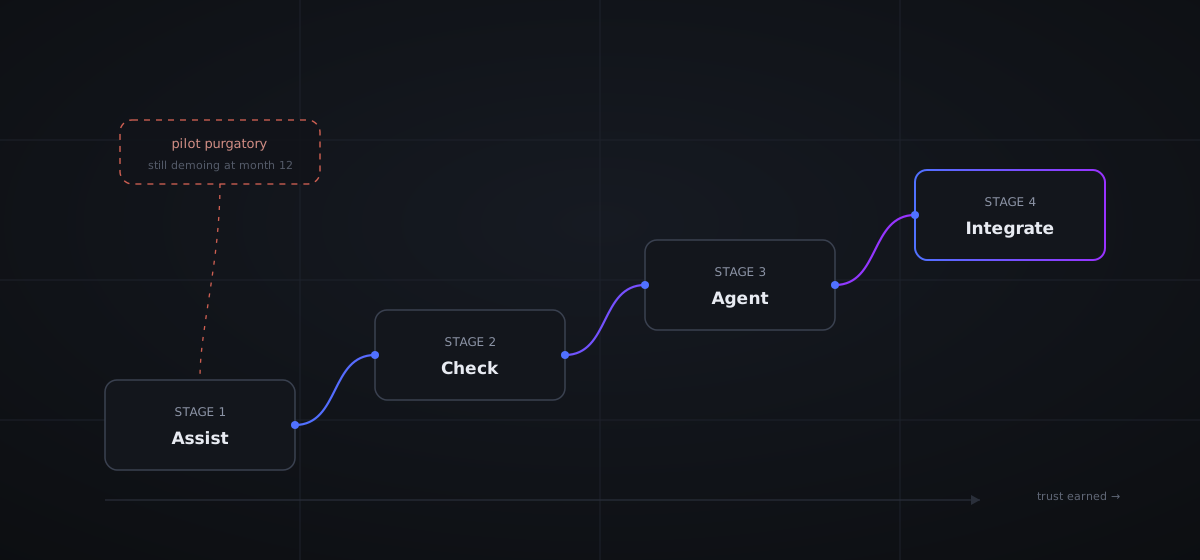
An internal AI program for electronics is a platform build wearing a pilot's clothing. Five problems decide the outcome: fragmented data, tool integration, verification, staffing across three rare skill profiles, and permanent maintenance. Sequence value in stages (assist → check → agent → integrate), own the layer that encodes your engineering knowledge, and buy the plumbing that's identical for every company on earth.
The pattern to avoid: pilot purgatory
The failure mode is consistent enough to have a shape. Month one: an enthusiastic engineer wires a frontier model to a folder of datasheets and it answers questions impressively. Month two: leadership sees the demo; budget appears; the pilot expands. Month four: the first attempt at a real task — "review this actual schematic" — hits the wall. The model can't read the Altium file. The exported PDF loses the net names. Its component suggestions include a part that went EOL in 2024. An engineer catches a wrong pin assignment, tells the team, and trust drops to zero. Month eight: the pilot is "on hold pending further evaluation," which is corporate for dead.
Note what did not fail there: the model. Every wall the pilot hit was infrastructure — file access, data freshness, verification, workflow. That's the central fact of this whole domain, and it's covered in depth in why AI hasn't worked for electronics. What it means for a program is blunt: the demo proves nothing about the product, because the demo skips exactly the parts that are the product.
The five problems you're actually signing up for
1. Your data is fragmented and mostly unwritten
An AI program runs on context, and an electronics company's context is scattered across ECAD files, a PLM system, PDF datasheets, distributor portals, MCAD models, and — the largest share — the memories of senior engineers. The design rules that matter most ("never single-source connectors," "that regulator family had errata," "customer X requires automotive grades") are usually written down nowhere at all. Before an agent can apply your engineering standards, someone has to extract them into a form a system can hold. Budget real time for this; it's archaeology, and it only goes as fast as your most senior people's calendars. (The structural version of this problem is the fragmented electronics ecosystem.)
2. Tool integration is a grind with no shortcuts
To do real work, agents need to read and write your actual design files — which means engaging with proprietary formats built to resist exactly that, per vendor, per version. Then the same again for your PLM's API, your distributors' APIs, and your MCAD tool. None of this is intellectually hard. All of it is slow, brittle, and permanent: every integration you build is an integration you now maintain through every upstream version bump, forever. Teams consistently estimate this at a quarter and spend a year.
3. Verification is the product, not a feature
The pilot dies the day an engineer catches the AI being confidently wrong, so the deterministic layer — ERC, DRC, netlist comparison, footprint-vs-datasheet checks, BOM lifecycle screens, all running as code on every AI output before a human sees it — is not an enhancement to build in phase two. It is the trust mechanism; without it you're shipping a liability generator with good UX. Alongside it you need evals: a regression suite of tasks with known-correct answers (schematics with planted errors, selection problems with defensible bests) so you can measure reliability and re-measure it every time you swap models. If you build only one sophisticated thing in year one, build this.
4. The team is three rare profiles in one room
The program needs electronics engineers (who know what correct looks like), software engineers (who can build and maintain the integrations), and AI engineers (who understand agents, context, and evals — a discipline with its own sharp edges, sketched in our agent concepts guide). Miss the EEs and you build tools engineers don't trust; miss the SWEs and prototypes never harden; miss the AI engineers and you make 2023's mistakes at 2026 prices. People fluent in even two of the three command whatever salary they like. Most orgs can assemble this team only by pulling their best people off product work — which is the real cost, and the one the pitch deck omits.
5. It's a treadmill, not a milestone
Frontier models leapfrog each other every few months; each swap shifts behavior enough to need re-evaluation. ECAD vendors ship format changes. APIs deprecate. The internal platform you finish in month eighteen enters, on month nineteen, a permanent maintenance phase costing a meaningful fraction of the build rate — indefinitely. Any plan whose budget drops to zero after "launch" is a plan to abandon the system in a year.
A staged roadmap that actually works
The programs that succeed share a sequencing discipline: each stage produces standalone value, and no stage bets on the next one arriving.
| Stage | What ships | Trust required |
|---|---|---|
| 1. Assist | Datasheet Q&A, requirements summarization, review-comment drafting — read-only, human transcribes | Low — errors annoy, nothing merges |
| 2. Check | Deterministic screens on human work: BOM lifecycle, footprint mismatches, rule violations | Earned by catch rate — code, not model |
| 3. Agent | Scoped agent tasks (part selection with live data, first-pass review) landing as diffs a human merges | Bounded by the review gate |
| 4. Integrate | The thread: requirements ↔ design ↔ BOM ↔ purchasing linked; agents work across it | High — and by now, evidenced |
Two rules make this work. Never skip stage 2 — checking is where trust is manufactured, and it's cheap. And never let stage 3 outrun the review gate: agents propose, humans merge, no exceptions, because a single unreviewed bad merge sets the program back to zero.
Build vs. buy is the wrong question
The honest framing is: which layers of this stack deserve your headcount? Because the stack splits cleanly.
The bottom layers — native format access, deterministic checkers, distributor and PLM integrations, diff-and-review infrastructure — are identical for every electronics company on the planet. Your ability to parse an Altium binary is not why customers buy your product. Building it in-house buys you 12–18 months of undifferentiated plumbing work and a permanent maintenance treadmill; this commodity layer is precisely what a harness platform exists to sell you, and precisely the thing worth buying. (Our own case for that layer: why you need a harness, not a chatbot.)
The top layers — your design rules, your preferred-parts logic, your review standards, your requirements and their links to your designs — encode your engineering judgment. That's your moat, it's the part only your people can write, and you should own it on top of whatever platform you run, portable enough to survive a platform change.
What good looks like at twelve months
A program on track looks unglamorous from the outside: engineers using assist tools daily without being told to; a deterministic check suite quietly catching real mistakes weekly, with a count someone can cite; two or three agent workflows producing diffs that engineers actually merge; an eval suite that runs on every model update; and — the tell — senior engineers arguing about how to encode their rules into the system, because that argument only happens once they believe it's staying.
A program off track also has a tell: it's still demoing. If month twelve's artifact is a better demo instead of a merge history, you're in purgatory — and the kindest thing leadership can do is stop, split the stack, buy the plumbing, and point the team at the layer only they can build.
Frequently asked questions
How long does it take to build an internal AI capability for electronics engineering?
Calibrate on this: a useful chatbot pilot takes weeks, but a trustworthy system that touches real designs — native ECAD access, deterministic verification, live component data, review workflow — is a platform build. Teams that have done it honestly report 12–24 months to production reliability with a dedicated team, and a permanent maintenance commitment afterward as models, tool versions, and APIs churn underneath it.
Why do most internal AI pilots in hardware companies fail?
The dominant pattern is pilot purgatory: a demo built on a clean example impresses everyone, then stalls, because between a demo and production sit unglamorous problems — reading proprietary ECAD formats losslessly, verifying outputs deterministically, grounding part data in live sources, and integrating with PLM and version control. Each is months of work, none of it was in the pilot's scope, and the pilot's sponsors budgeted for none of it.
What skills does an internal AI-for-electronics team need?
Three profiles that rarely coexist: electronics engineers who know what correct looks like and where designs actually fail; software engineers who can build and maintain integrations against ECAD formats, PLM systems, and distributor APIs; and AI engineers who understand agents, context management, evals, and model operations. Missing any leg produces a characteristic failure — tools nobody trusts, prototypes that never harden, or systems that can't be measured.
Should we build our AI tooling in-house or buy it?
Split the stack. The layers that are generic across every electronics company — file format access, deterministic checkers, distributor integrations, review infrastructure — are commodity harness plumbing with no competitive differentiation, and buying them saves 12–18 months. The layers that encode your proprietary knowledge — design rules, preferred parts, review standards, requirements — you should always own, whichever platform they run on. Build-vs-buy is a false binary; the real question is which layers deserve your headcount.
James Pentalow
James is a two-time founder and GTM lead at Circuitly. He's spent almost a decade working with customers in the electronics space and has been building agentic systems since 2022.
Skip the two-year platform build.
Circuitly is the harness layer — native ECAD access, deterministic checks, live data, Git review — delivered, so your team starts at the workflow stage instead of the plumbing stage.
Book a Call